A Hidden Ceiling isn't a skill gap or a knowledge gap. It's an identity gap.
It's the distance between the leader you've been rewarded for being and the leader you'll need to become.
You may already sense it. A quiet friction. The feeling that the moves that got you here aren't quite working the way they used to. But without a name for it, it stays invisible, and what stays invisible can't be changed.
Naming your Hidden Ceiling is the first act of breaking through it.
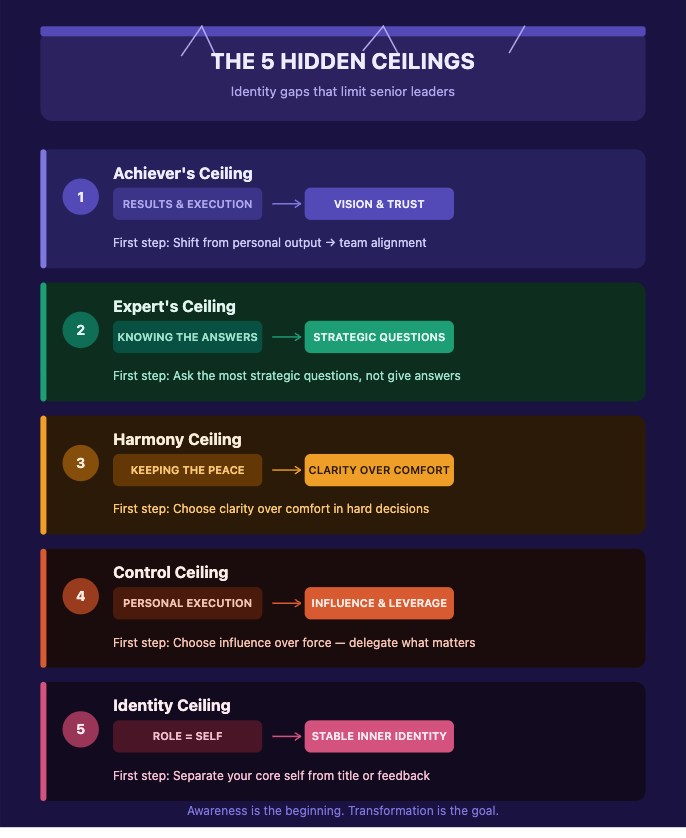
Here are the five most common Hidden Ceilings I see in leaders, and the first step to breaking through them:
1. The Achiever's Ceiling — You've built your identity around results, delivery, execution, and getting things done. The ceiling appears when your organization needs vision and trust-building. You keep driving harder at a game that has quietly changed. The First Step: Shift your focus from personal output to team alignment.
2. The Expert's Ceiling — You became senior because you knew more than others. Leadership now requires influencing people who know more than you in their own domains. Being the smartest person in the room is no longer the point. The First Step: Transition from providing the best answers to asking the most strategic questions.
3. The Harmony Ceiling — You've built real trust by keeping the peace and making people feel heard. The ceiling appears when hard decisions need to be made. Conflict avoidance has a cost that compounds quietly over time. The First Step: Choose clarity over comfort.
4. The Control Ceiling — You built your reputation through personal execution. True delegation feels like risk rather than leverage. The ceiling is reached when your span of responsibility exceeds what any one person can personally oversee. The First Step: Choose influence over force.
5. The Identity Ceiling — Your sense of self is closely tied to your role and title. When the role changes or a major transition looms, you find yourself without a stable internal foundation. Success begins to feel fragile. The First Step: Separate your core identity from moment-to-moment feedback or structural roles.
Awareness is the beginning.
Real transformation happens when you learn how your internal patterns are shaping your leadership in real time
Which of these do you see impacting your leadership?
I would love to hear from you. Drop me a note